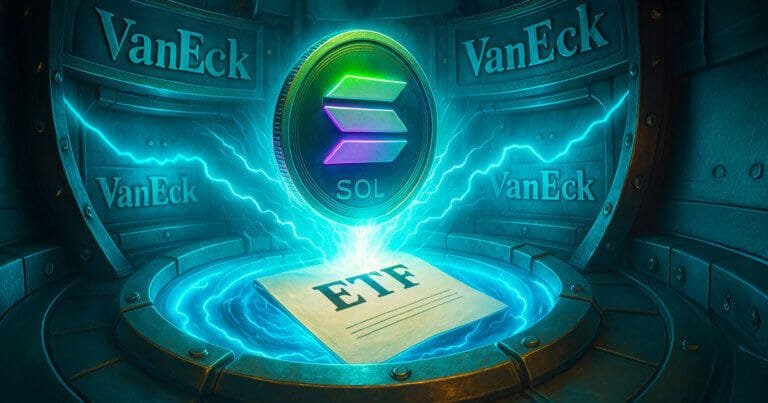
Global investment firm VanEck has submitted an S-1 filing to the U.S. Securities and Exchange Commission (SEC), seeking approval to launch the VanEck JitoSOL ETF. If approved, the fund would be composed exclusively of JitoSOL, a liquid staking derivative created by Jito Network.
This filing represents the first attempt to register a U.S.-listed ETF tied directly to a liquid staking token, opening the door for investors to access Solana staking rewards through a regulated financial product. JitoSOL functions as a tokenized version of staked SOL, allowing holders to earn validator rewards while maintaining liquidity — a model widely known as liquid staking.
The move extends VanEck’s footprint in the crypto ETF space. The firm already rolled out a spot Bitcoin ETF and an Ether ETF earlier in 2024, but unlike those, the JitoSOL product will test how regulators treat staking-related assets.

SEC’s Uneasy Relationship With Staking
VanEck’s proposal comes shortly after Jito Labs and the Jito Foundation, with backing from VanEck, Bitwise, Multicoin Capital, and the Solana Policy Institute, sent a joint letter to the SEC on July 31. The letter urged the regulator to allow liquid staking tokens in exchange-traded products (ETPs), arguing that these assets make staking more secure and scalable by spreading stake across multiple validators while simplifying operations.
They highlighted that current SEC guidance suggests most forms of staking don’t count as securities transactions. In particular:
- May 2024: SEC staff stated that solo and delegated staking generally fall outside securities rules, since rewards are set algorithmically by the protocol.
- August 2024: The SEC extended that logic to liquid staking, framing tokens like JitoSOL as proof of ownership, not investment contracts — as long as providers don’t have discretionary control.
However, these staff interpretations aren’t binding law and could be overturned or reinterpreted by the Commission or the courts.
The SEC’s position has shifted notably over time. In February 2023, the regulator went after Kraken, forcing the exchange to shut down its U.S. staking services and pay a $30 million fine. Later that year, it also sued Coinbase over staking offerings — a case that was ultimately dismissed in February 2025.
ETF Precedent
Staking has also been a sticking point in ETF approvals. When the SEC signed off on spot Ether ETFs in May 2024, issuers initially wanted to include staking as part of the funds. Regulators rejected that idea, forcing issuers like BlackRock, Fidelity, Grayscale, and VanEck to strip out staking before approval.

As a result, today’s Ether ETFs hold ETH only, with no staking component. Whether VanEck’s JitoSOL ETF can break that barrier may determine the future of staking-focused investment products in the U.S.
Download the FREE Bitcoin Mining eBook
Kickstart your mining journey with essential insights:
https://bitmernmining.com/landing-page-ebook-download/
For more news, find me on Twitter Giannis Andreou and subscribe to My channels Youtube and Rumble
What is your opinion on this particular topic? Leave us your comment below! We are always intere