
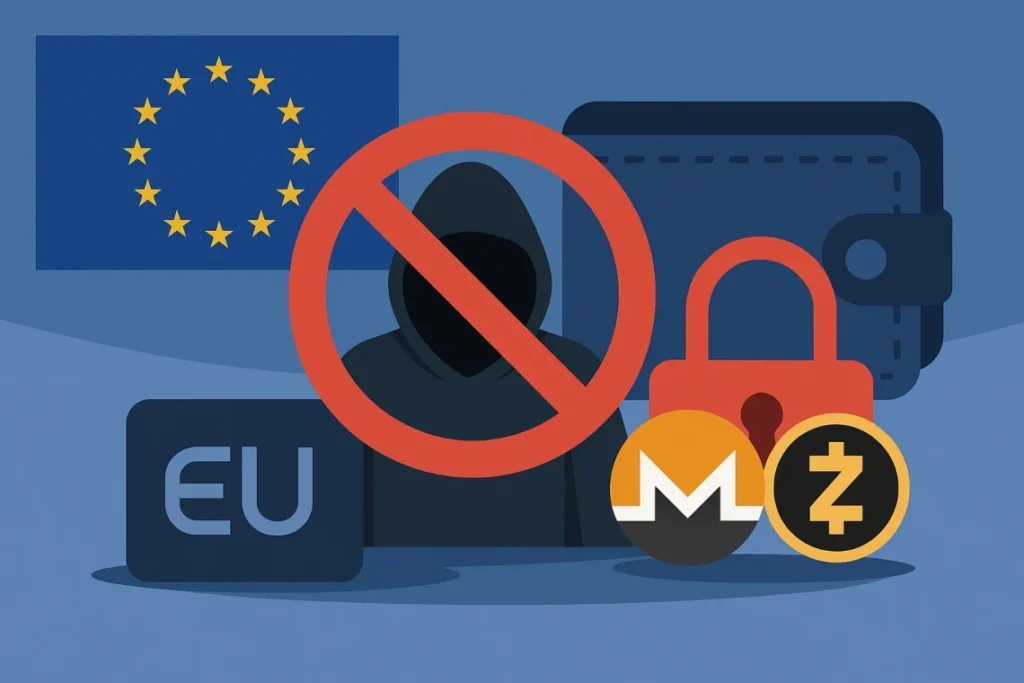
The European Union is preparing to enforce strict anti-money laundering (AML) regulations that will outlaw the use of anonymous crypto accounts and privacy-focused cryptocurrencies starting in 2027.
The new Anti-Money Laundering Regulation (AMLR) will make it illegal for banks, financial institutions, and crypto asset service providers (CASPs) to offer or maintain anonymous services or handle coins that obscure transaction data, such as Monero (XMR) and Zcash (ZEC).
According to the AML Handbook published by the European Crypto Initiative (EUCI), Article 79 of the AMLR mandates a full ban on anonymous crypto accounts. This rule applies broadly to financial service providers, including those dealing in crypto assets, and explicitly targets services that enable transaction anonymity.


The upcoming regulation is part of a larger EU initiative to tighten financial transparency. It covers a wide range of instruments—from bank and payment accounts to crypto wallets and privacy-enhancing coins—that facilitate anonymous transactions.
Vyara Savova, the EUCI’s senior policy lead, stated that although the core legislation is finalized, several details will be ironed out in upcoming implementing and delegated acts, mostly overseen by the European Banking Authority. She emphasized that the EUCI continues to engage in consultations to influence how these rules are put into practice.
Savova also warned that crypto platforms regulated under MiCA will need to start adjusting their compliance frameworks now, given that the foundation of the new rules is already set.
Enhanced Monitoring for Crypto Providers
As part of the updated framework, crypto service providers operating across six or more EU countries will face direct AML scrutiny. Initially, the new Anti-Money Laundering Authority (AMLA) plans to select 40 entities—ensuring at least one per EU member state—for supervision starting July 1, 2027.
To qualify for direct oversight, companies must meet certain thresholds, such as serving at least 20,000 customers in a member state or facilitating over €50 million (approx. $56 million) in transactions.
In addition, the new rules require mandatory customer identity checks for any crypto transactions over €1,000 (around $1,100), reinforcing the EU’s push for greater transparency and accountability in the digital asset space.
These developments mark a significant tightening of crypto regulations in the EU, following frameworks like MiCA and now extending into stricter AML enforcement.
For more news, find me on Twitter Giannis Andreou and subscribe to My channels Youtube and Rumble
What is your opinion on this particular topic? Leave us your comment below! We are always interested in your opinion!